
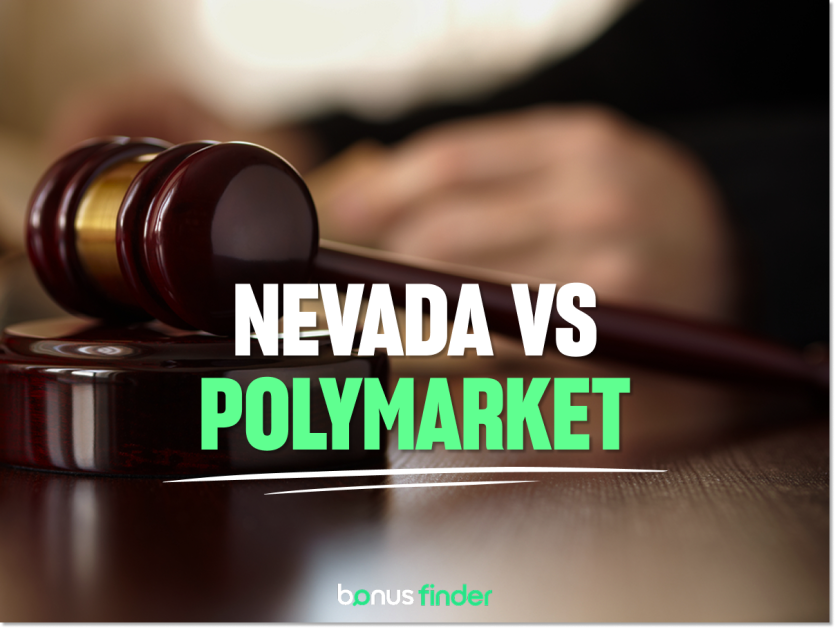

Predictions platform Polymarket has been hit by its first US lawsuit, as the Nevada Gaming Control Board (NGCB) takes the operator's product to task in Carson City District Court. This is due to the platform lacking regulation unlike online sports betting which is legal and regulated within Nevada.
In a document submitted on January 16, the NGCB implores the court to administer a "declaration and injunction to stop Polymarket from offering unlicensed wagering in Nevada."
The announcement marks Polymarket's first major hurdle following its stealth re-entry to the domestic industry – the derivatives platform returned to the US in December 2025, some three years after winding down national services.
This action represents the latest in a growing wave of anti-prediction maneuvers. But is a decision in Nevada's favor realistic?
NGCB plots to shut down "unlawful" Polymarket contracts
Polymarket offers online sports and events contracts across the US, where customers may purchase shares on certain outcomes.
The NGCB is particularly unhappy with the operator's sports markets – as outlined in the official lawsuit statement:
"Polymarket operates a derivatives exchange and prediction market where it offers event contracts for sale. These products are offered for sale on Polymarket's mobile app and are made available to people in Nevada.
"The Board considers offering sports event contracts, or certain other event contracts, to constitute wagering activity under NRS 463.0193 and 463.01962 and, therefore, entities offering such event contracts must be licensed."
Dubbing Polymarket as an "unlawful" operator, the Board also cited economic and resident welfare as core pillars for regulated wagering:
"The Board has deemed Polymarket's operations to be unlawful in Nevada and in violation of NRS 463.160, NRS 463.350, NRS 465.086, and NRS 465.092.
"Nevada's public policy, as expressed by the Legislature, is that the gaming industry is vitally important to the economy of the state and the general welfare of the inhabitants and therefore must be licensed, controlled, and assisted to protect the public health, safety, morals, good order, and general welfare of the inhabitants of the State."
Despite launching this anti-Polymarket civil enforcement within the confines of Nevada, recent history suggests that the result of the NGCB's lawsuit will be decided at a federal court…
Federal law may determine the outcome of NGCB lawsuit
This is not the first time that a prediction platform has come under fire from states. Lawmakers in New York, Pennsylvania, Massachusetts, New Jersey, Maryland and South Carolina have taken aim at contract-based services primarily Kalsh for operations that are widely perceived as being illegal.
But the important factor is this: to date, states have tended to issue cease-and-desists instead of lawsuits. More often than not, operators retaliated with litigation of their own.
It is that point which makes the NGCB's latest move especially notable; Nevada is only the second state to bring a predictions operator to court.
In fall 2025, Massachusetts attempted to shutter Kalshi's sports contracts service via a still-ongoing lawsuit.
Polymarket to use Kalshi's tactics
Potentially, Polymarket will likely leverage the same argument upheld by Kalshi: prediction platforms are derivative trading services, and are therefore regulated by the Commodity and Futures Trading Commission (CFTC).
The CFTC is a federal organization, and Polymarket is expected to assert that federal law overrules that of the states.
Unlike the aforementioned cease-and-desists, Polymarket cannot immediately take proceedings to the federal court level using that argument.
As the NGCB suit is directly placed against Polymarket and its operations within Nevada's borders, the firm must prove that federal statutes completely preempt state law.
Success for either party would signal a critical shift in the rapidly evolving predictions-versus-states landscape.
Should the NGCB gain support from federal courts, a tide of uncertainty will hit the sports trading industry.
Whereas, if Polymarket succeeds in its defence and potential counter-attack against the nation's most important gambling market, it would mark one of the fiercest challenges to licensed wagering this decade.
States now teaming up to combat predictions operators
A separate – yet equally important – case is taking place in California, as tribal gambling operators seek to take down predictions products.
Tribes contend that prediction platforms like Kalshi and Polymarket provide services that are identical to sports betting. California's current gaming framework stipulates that only tribal groups are permitted to support such facilities.
The initial case stumbled quickly, with a Ninth Circuit judge declining injunction requests that, if allowed, would have blocked customers from accessing accounts tied to sports trading entities and halted a Kalshi marketing campaign describing its services as being available nationwide.
Now, the American Gaming Association (AGA), an alliance of 27 states and Washington, D.C. have presented 'amicus briefs' supporting the tribal cause.
Amicus briefs (also known as 'friend of the court' briefs) are submissions from individuals or groups with significant interest in the outcome of a decision. Members behind these letters often provide additional information, insight, viewpoints and expertise.
Here, states are pointing out that US District Court judge Jacqueline Scott Corley may have overlooked or misinterpreted language within the Unlawful Internet Gambling Enforcement Act (UIGEA) which says that there exists no provision for the UIGEA to override the Indian Gaming Regulatory Act – the very act that allows Native American tribes to support sports gambling in the Golden State.
In short: the AGA and states signed to the amicus brief dispute that prediction platforms are not exempt from regulation just because they operate under federal jurisdiction.
Possible ramifications for prediction platforms across the US
The Ninth Circuit is among the nation's most influential courts, and any decision could affect rulings elsewhere.
Favoring tribal groups may set a precedent for regulation. On the flipside, a resolution benefitting predictions operators could reinforce the belief that sports derivatives are not subject to state regulation.
One vital detail must be addressed amidst this cross-state drama; the US President's eldest son, Donald Trump Jr., sits on Polymarket's Board. Moreover, the operator settled its 2022 disagreement with the CFTC when President Trump assumed office.
It stands to reason that as Polymarket faces action across additional jurisdictions, analysts and sports betting operators may question the optics of court rulings favoring prediction operators – particularly after one individual pocketed $436,000 after backing the US to capture Venezuelan President Nicolas Maduro minutes before the official announcement, and declined payouts following the US 'special operation' in Venezuela.