
South Carolina casino bill promises 35% conservation pledge strong opposition
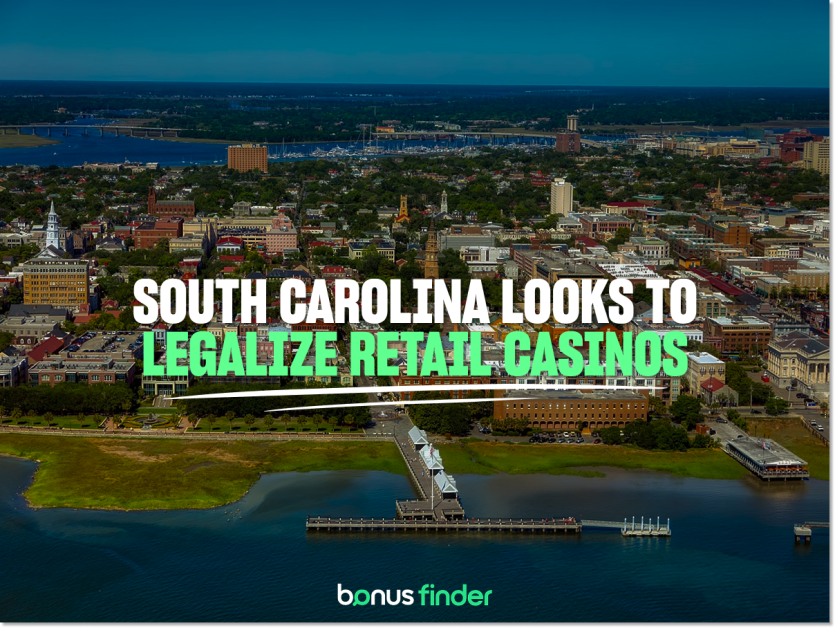
Lawmakers in South Carolina are weighing a Bill to legalize retail casino gambling and install a state-run gaming commission. If successful, the motion promises to offer significant financial contributions to local conservation efforts.
Introduced in March 2025, House Bill 4176 seeks to allow casino gaming via licensed operators located along the I-95 – which is among the highest-circulation highways in the US – and distribute key conservation funding.
However, opposition groups remain steadfast in their stance against gambling, and legislators face an uphill battle to push HB4176 into law.
What would HB 4176 do if passed?
Officially titled the I-95 Economic and Education Stimulus Act, HB 4176 is designed to establish a casino presence within some of South Carolina's most financially underprivileged counties.
Eligible counties must be designated as Tier IV by the Department of Revenue. Officials interested in launching a retail gaming industry within their area would need to submit a gambling license request and enter into an agreement with a partner gaming entity.
And, although the proposal specifically targets I-95 expansion, officials presiding over eligible regions may construct casino facilities anywhere within their county.
Further, HB 4176 would necessitate the formation of a new state gaming commission comprising three members.
Under the Bill, the Governor, Senate President and House Speaker are each charged with appointing appropriate candidates to represent this regulatory organization.
If successfully integrated, the South Carolina Gaming Commission would award licenses to qualifying parties and oversee all gambling activities in the Palmetto State.
State to benefit from significant gambling revenue commitments
According to HB 4176, casino operators must undertake an independent economic impact study and invest "at least" $200m in property and infrastructure development. A non-refundable $500,000 operator application duty and a refundable $2m licensing fee also apply.
Lastly, a $500,000 annual charge shall be paid by all registered gaming firms.
Awarded licenses will remain active for 15 years. Operators may request five-year extensions beyond this period.
Other financial contributions include a 15% 'privilege tax' on an operator's adjusted gross gaming revenue (GGR), calculated by subtracting the value of all payouts from total placed wagers.
State windfall is expected to range between $149m and $262m per year, which would see annual privilege tax revenue sit in the region of $22.3m to $39.3m.
In a statement, the state General Assembly conceded that although gambling "is not consistent nor compatible with" most communities in South Carolina, tangible benefits may be derived from a regulated gambling scene:
"The General Assembly further finds that casino gaming in these (financially disadvantaged) counties is consistent and compatible with their economic, labor and tourism profiles and that revenue, job creation and economic improvement from such gaming would substantially increase the educational opportunities of children living in these areas."
Casino backers make conservation pledge as political tensions bubble
South Carolina is widely recognized as a staunchly anti-gambling state – with consistent constraints halting retail and iGaming legalization processes.
Conservation advocates, religious sects and politically-motivated parties have historically opposed any form of regulated gambling industry.
In an effort to curb such stalwart resistance from at least one of these groups, HB 4176 pledges to attribute 35% of all casino revenue to the South Carolina Conservation Bank.
It is hoped that this commitment will allay development fears by essentially reimbursing the state's conservation fund for potential wildlife and forest disruption during and after casino development.
Speaking to local news outlet, The State, Republican Representative and Bill supporter Bruce Bannister did not shy away from the fact that HB 4176 needs support from conservation activists:
"Most of the members are sort of lukewarm, but if it helps something they care about, like conservation, they would be more favorable. Having that farm security that we can grow our own food and having those lands in South Carolina conserved would be a huge deal."
Thus, HB 4176 is more than a simple gambling bill. It is now divided into three clear divisions:
- One part gaming and revenue expansion.
- Another part is land and wildlife preservation.
- As well as being a community-focused motion pursuing financial upswing for impoverished jurisdictions.
Religious opposition remains a near-insurmountable hurdle
On January 15, members of several South Carolina religious congregations met to celebrate Pastor's Day at the Capitol – an annual event where leaders and other notable figureheads discuss the responsibility of religion across modern society.
This year, gambling legalization – or rather, multi-denomination anti-gambling measures – was on the docket.
Faith Wins, an education, mobilization and activation nonprofit organization, expressed that over 175 pastors hailing from 11 denominations would jointly oppose any gambling bill:
"Christians will not stand for policies that exploit communities and weaken families. When people of faith unite to stand for their communities and speak truth with conviction, faith wins."
The influence of Christianity runs deep in South Carolina – proven by Palmetto Family Council President Steve Pettit declaring the proposed gambling amendment a "moral" issue that decries holy scripture: "This is not a fiscal issue, this is a moral issue. Scripture warns against unjust gain."
Governor opposes gambling as a remedy for impoverished counties
Perhaps the most significant roadblock for Rep. Bannister and HB 4176 is that South Carolina Governor Henry McMaster also stands against gambling legalization.
Speaking in spring 2025, Gov. McMaster hinted that he may veto any gambling legislation presented at his desk – dubbing casino entertainment as "bad for our (South Carolina's) culture".
Elected for a second term as Governor in 2022, McMaster is eager to uncover alternative routes toward fiscal advancements in the state:
"There are better ways (than gambling) to make money, to give jobs, to generate tax money, to generate a thriving economy."
Crucially, any bill that achieves more than two-thirds support from legislators cannot be undone by Governor veto.
Tribal support could be key to casino gaming in South Carolina
Despite being one of very few advocates for gambling in South Carolina, not once in the seven-page HB 4176 document is the Catawba Nation tribe mentioned.
The tribe currently operates a bingo service – following years of unsuccessful casino pleas – and built a retail casino in North Carolina.
Reporting suggests that the Catawba Nation had been collaborating with Republican Party donor Wallace Cheves to set out a clear path for the I-95 casino project, but the relationship quickly strained.
Tribal and political realignment appears unlikely – but such a rekindling could unlock the requisite insight for further support, as has already been demonstrated when Maine became the eighth state to legalize online gambling this year.
Further meetings are anticipated throughout January and into spring, in what could be the nation's most remarkable US gambling legalization process this decade.