
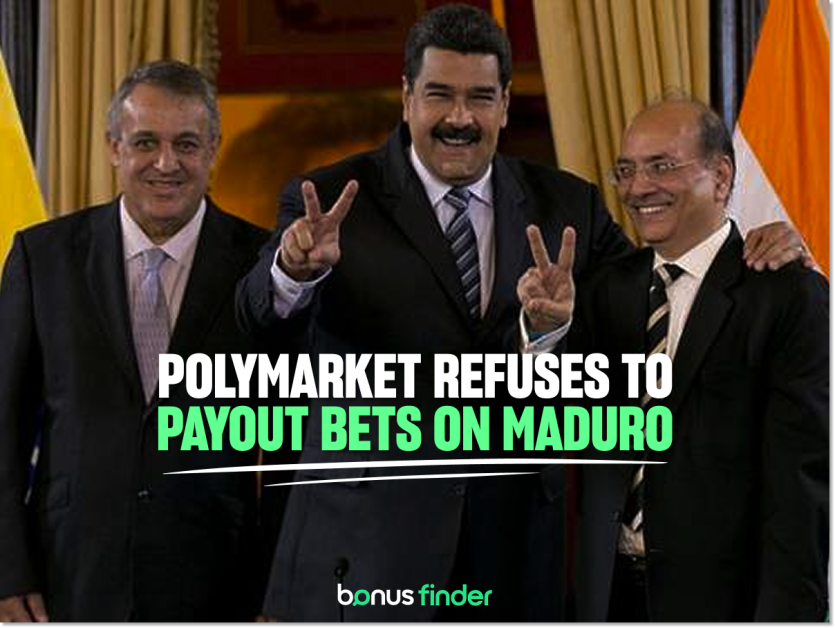

A US-based prediction market where people can wager on yes/no outcomes of real-world events - Polymarket - has refused to settle and pay out bets on a market asking whether the United States would "invade" Venezuela. Prediction markets operate in a similar way as sportsbooks, except you bet on the outcome of a specific thing.
Despite a US special forces operation ending with the capture of Venezuelan President Nicolás Maduro, Polymarket's official stance is that the recent US military raid and capture does not legally qualify as an "invasion" under specific wording.
According to Polymarket, "US military operations intended to establish control over any portion of Venezuela", was required in the contract.
They argue the operation was a limited "snatch-and-extract" mission, not a sustained offence to seize control of Venezuelan territory.
President Trump's comment about "running" Venezuela was, at least according to Polymarket, insufficient to meet that definition by itself.
That has led to a lot of anger and frustration, given around $10.5m is tied up in these unresolved "invasion" contracts.
What are prediction markets?
Prediction markets are considered legal and financial products, paid out when written conditions are met, not based on lay or media definitions. Strict interpretations should help avoid ambiguity and reduce manipulation or legal exposure.
Had Polymarket accepted any military action as an invasion regardless of intent or control, that could create endless disputes for future contracts. People may argue that users also bear responsibility for reading contract wording before placing bets.
Bettors rebel against Polymarket
Gamblers are furious and have accused Polymarket of arbitrarily redefining terms after the event to avoid large payouts, along with 'moving the goalposts' and ultimately being unfair in how outcomes are judged.
Bettors claim that Polymarket has undermined their trust in prediction markets when real-world events don't fit neatly into contract wording.
Although, prediction markets are increasingly asked to judge geopolitical events that don't have clean yes/no outcomes.
This has led to criticism, with critics worried that strict technical definitions may systematically bias towards "no" for complex geopolitical events such as this one.
One anonymous trader appeared to stake $30,000 which turned into over $430,000 on a related Venezuela market.
Following Polymarket's refusal to pay, the subsequent backlash intensified and concerns regarding insider trading were raised.
Why Polymarket didn't pay out on Maduro
After the company claimed that the seizure of Maduro didn't qualify for a winning bet, the odds of an invasion before the end of January crashed to below 5%.
Disputes have subsequently arisen, not just on this market, but broader questions and issues regarding transparency and fairness when a centralised platform both writes the contract and ultimately decides its resolution.
Bettors are curious as to how prediction markets will define and resolve events that don't have clear outcomes in the real world. Regulatory and oversight gaps in prediction markets, especially when large sums of money and geopolitical events are involved, could now come under intense scrutiny.
Prediction markets rely on precise language. Therefore if the contract doesn't define "invasion" in terms that match a real-world event, the outcome may not meet the contract's terms even if most people think it does.
It's difficult to gauge whether real outcomes match up with contract wording, but Polymarket have defended this interpretation by pointing to their specific written conditions.