
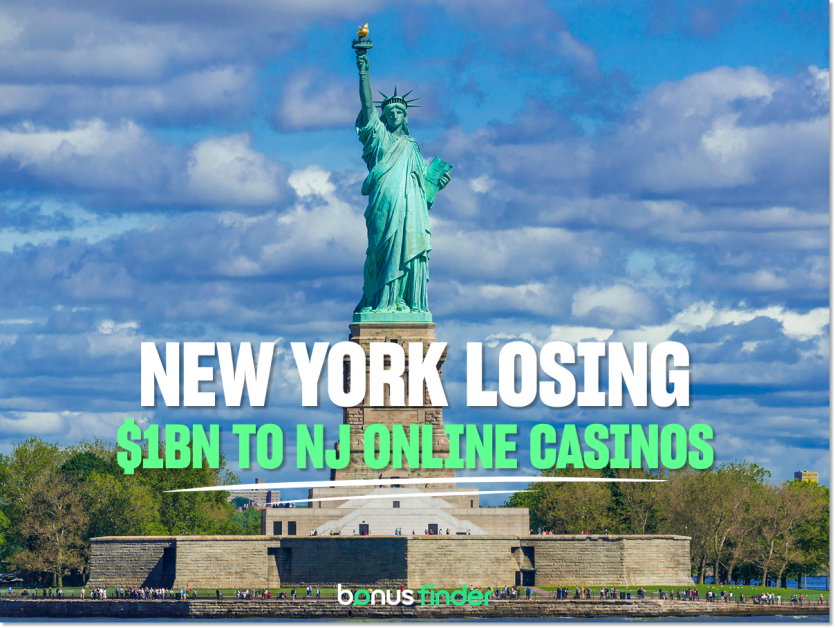

A New York Senator, Sen. Joe Addabbo, leading the charge to legalize online casinos has claimed that a lack of iGaming infrastructure is costing the state over $1bn annually.
In an attempt to overcome this fiscal bleed, Sen. Addabbo, a Queens-based Democrat, has introduced a fourth successive online casino bill in the Big Apple.
His efforts until now have proven fruitless, with lackluster support from Governor Kathy Hochul being a major factor behind his motions' failures:
"I start every session optimistic. But it's a budget process. It can't just be me. Every state that has it is because the governor wanted to do it or needed to do it, and I think that's where we're at."
Sen. Addabbo outlined that he is reintroducing his iGaming legalization bill, SB 2614, to recoup funds currently being surrendered to other markets:
"For every year we don't do it (legalize online casinos), we lose about a billion dollars to New Jersey, Connecticut, Pennsylvania and the illegal market."
His figures add up. New Jersey online casinos reported gross gaming revenue (GGR) or $2.91bn in 2025. In Pennsylvania, GGR for the same year sits above $3bn. Connecticut's online market is also developing steadily, outpacing the land-based New York industry.
Between April to December 2025, New York's land-based casinos netted just $525.6m GGR. The contrast is clear.
Unregulated iGaming puts minors at risk, says Addabbo
Addabbo, who also serves as Chair for the Senate Racing, Gaming and Wagering Committee, agrees with Governor Hochul on the matter of protecting minors from online gambling.
In a statement, Sen. Addabbo posited that the primary reason New York has seen success in the mobile sports betting scene is down to regulation – iGaming does not benefit from that same oversight.
"Since mobile sports betting is a regulated industry in New York, we have the ability and responsibility to implement measures that prevent underage participation and promote responsible play. At the same time, this effort underscores a broader truth. When gaming is regulated, we can protect players.
"We should apply the same principle to legalize iGaming, so that all New Yorkers, including minors who are already currently participating in iGaming through apps in other states and illegal sites, can benefit from strong consumer protections, transparency, and oversight."
While revenue projections represent a partial driving force behind Addabbo's iGaming push, the Senator acknowledges a glaring need for stronger safety measures: "When I advocate for iGaming, yes, it's sustainable revenue. But it's about protecting the New Yorker doing it in an unsafe manner, including minors."
But the 61-year-old understands that much responsibility rests on his shoulders when it comes to supporting iGaming legislation. In an interview with Gambling Insider , Addabbo affirmed that he "will start the conversation" around online casino legalization amid silence among peers.
Could Governor Hochul soften her anti-iGaming stance?
At the turn of the year, Governor Kathy Hochul praised the New York Gaming Commission's decision to award retail casino licenses to Resorts World, Bally's and Hard Rock.
Governor Hochul lauded that these casino complexes would "generate billions of dollars" for education, create thousands of jobs and provide tangible benefits for residents.
Yet, that sentiment has not been extended to online casinos – culminating in frustration from Senator Addabbo:
"If the Governor doesn't want the revenue, if the Governor doesn't want to help people with addiction, if the Governor wants to still see our money go to another state, then we don't do it. I don't know what rational Governor would want to do that."
But Addabbo believes that developing a legal iGaming market is a purely financial issue – and as proven by Gov. Hochul's confidence in retail casinos, she could be swayed by immediate fiscal results.
For Addabbo, this means accumulating "up front money" via license fees; something fresh in the mind of Hochul following 2025's $1.6bn licensing fee haul for the state.
New York casino bill addresses Governor's key concerns
Throughout the past year, Governor Hochul has remained steadfast in her approach to gambling: player protection comes first, revenue second. This is proven by her latest endeavor – directing the NYGC to explore biometric security protocols, such as facial recognition technology, in an effort to curb gambling harm.
At the same time, the 2021-elected official has overseen a sports betting boom in New York since 2022, generating over $4bn in under half-a-decade.
For iGaming legislation to make headway, it must demonstrate to Gov. Hochul that it will not only service the state but also individual players.
Addabbo's proposed framework strikes at the core of both concerns.
- First, his motion would enforce regulatory iGaming and iLottery measures akin to those protecting sports bettors and retail casino players.
- Second, the Bill would apply a flat 30.5% tax rate to all iGaming revenue and require operators to pay $2m in licensing fees.
Although that duty sits well below New York's 51% operator charge, Addabbo maintains that this is simply a "starting point" and remains open to modifying certain figures.
He also underlined the potential for cross-promotion among brands supporting retail and online verticals – a facet that has reaped rewards in Pennsylvania and New Jersey.
Addabbo fears New York will fall behind nearby states
"Technology is advancing and you can't stop it", says Addabbo. "It's going forward, so let's work with it."
Surrounded by three states currently supporting online casino products, Addabbo wants New York to leverage its perception as a "growth market" to evaluate "gaming on a large scale".
"Let's roll up our sleeves and get the job done."
Debates over licensing new casino venues in Queens and the Bronx consumed attention in 2025 – decision-makers undertook day-trips to each casino bidder and held multiple hearings before awarding certification.
With those distractions removed, Addabbo views 2026 as an "opportunity" to focus on iGaming expansion.
Addabbo open to collaborating with prediction platforms
As several states take aim at prediction operators such as Kalshi and Polymarket, Senator Addabbo wonders whether a regulated framework could ease tensions – a viewpoint consistent with his regulation-over-prohibition iGaming stance.
"I'd like to have New York go with Kalshi and others with a regulated mechanism."
Specifically, he argues that placing tax requirements on prediction firms would result in an improved market:
"We have (sports betting) operators paying 51% – what if someone like Kalshi is not paying anything and it's creeping into that? How do you address it? Regulate it."
Before addressing prediction concerns, Sen. Addabbo must await the outcome of his iGaming bill. Its next destination is the Assembly Floor.
Should SB 2614 advance through the Assembly and Senate, it will land on Governor Hochul's desk, where a pivotal decision may await.