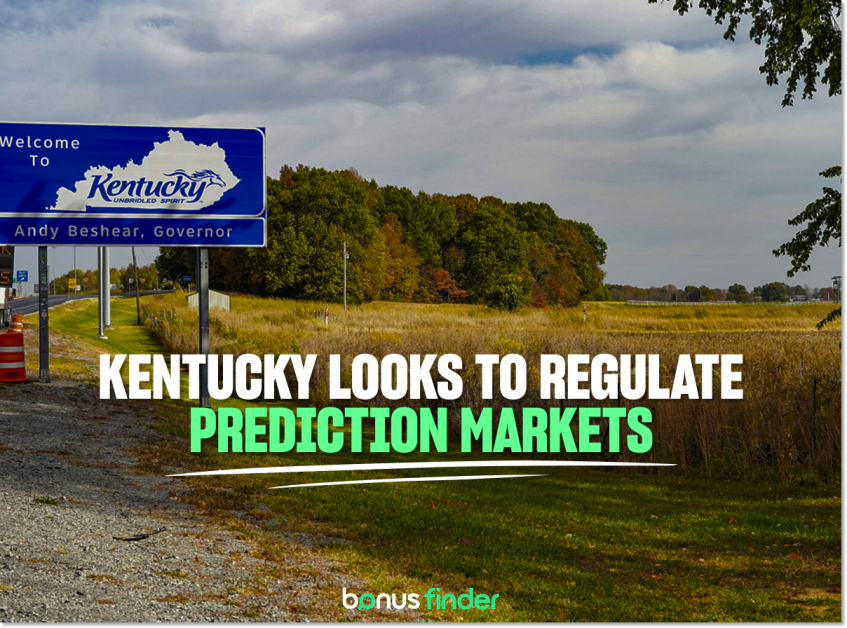

The Kentucky House of Representatives last week passed a sweeping Bill to tax prediction platforms and restructure traditional gambling rules. BonusFinder, an online casinos comparison site, gives you the latest.
House Bill 904 – passed by a 79-15 vote – seeks to:
- Raise the legal gambling age from 18 to 21
- Legalize daily fantasy sports (DFS) contests
- Outlaw college player prop bets and bring about fixed-odds wagering
If passed, these changes would stand as some of the most noteworthy in the domestic industry. The proposal could also see prediction operators blocked from partnering with licensed racetracks and forced to contribute to state taxes.
However, that decision may induce undesirable consequences, with dual-purpose sportsbook-prediction operators potentially forced out of the state from 2027 as a result.
The Bill is now on course for a Senate review, where chamber members will determine whether any changes should be made before potential signing into law by Governor Andy Beshear.
Bill to legitimize prediction platforms?
While many states are currently engaged in active legal warfare against prediction market operators like Kalshi and Polymarket, Kentucky's HB 904 takes a distinct stance.
Rather than directly attacking the legitimacy of these contract-based trading options, the Bluegrass State is both preemptively preparing for prediction platform regulation and protecting its traditional gambling industry.
Here's how:
- Taxation: HB 904 sets out a plan to tax prediction platforms at 14.25% – the same rate applied to existing sportsbooks.
- Partnerships blocked: Prediction platforms would be blocked from entering partnerships with racetracks, licensed for sports betting and DFS operators, preventing ecosystem overlap.
In 2027, that partnership ban would apply to all domestic prediction platforms – blocking trading operators across the nation from teaming up with local racetracks. Under this rule, sportsbook accords with partnership with track operators would be deemed illegal.
Crucially, taxing prediction operators does not signal a desire from lawmakers to legitimize sports trading derivatives.
Rather, the maneuver to tax prediction platforms stands as a protective mechanism, should any federal ruling determine that states cannot prevent such operators from facilitating trades.
In the meantime, HB 904 blocks prediction operators from joining accords with existing sportsbooks – such as DraftKings or FanDuel – to halt possible dual-system products. Without this restriction, there is a possibility that prediction operators could have either provided market fluidity for sportsbooks or leveraged a partner's services for brand expansion.
State treating prediction platforms as sports betting
Under this proposal, sportsbooks and prediction markets would fall into the same taxation bracket of 14.25%.
That figure conveys what many states have argued to this point: sports-based prediction markets equate to traditional gambling.
Rep. Michael Meredith – a sponsor of HB 904 – touched on prediction operators entering the sports and "ball games" space ahead of last week's vote:
"Prediction markets have started moving into the space of betting on ball games, sporting events, and even prop bets on athletics as well," said Meredith.
"We put a tax on those prediction markets and their derivatives and swaps equal to what the sports wagering tax is on online sports wagering. We also say that if you are a licensee under this Bill through sports wagering, a horse racing track, or a fantasy sports operator for the next year, you can't operate a prediction market in Kentucky."
DraftKings, FanDuel may be forced out of Kentucky
The original iteration of HB 904 expressly barred in-state racetracks from partnering with any US entity that offers prediction market facilities nationwide as soon as the Bill is signed into law.
However, three core sports betting operators – FanDuel, DraftKings and Fanatics – are each partnered with land-based racetracks, and all have launched US sports trading derivatives within the last several months.
If HB 904 were to be enacted under its first guise, these market leaders would have been forced out of Kentucky immediately.
Fearing such an outcome, the three operators submitted joint testimony detailing that the Bill might "force" regulated license-holders to withdraw from the State.
Meredith promptly altered the Bill's conditions, and HB 904 will only require operators to exit Kentucky if they offer prediction markets anywhere in the US in mid-2027.
Consequently, the sportsbook trio have just under 18 months to prepare for an ousting from the Kentucky market.
Meredith was clear on the prospect of sportsbooks-turned-predictions operators departing Kentucky: "After that (2027 deadline), you're not allowed to be involved with or in business as a prediction market operator anywhere else in the country if you're licensed under one of our licensee structures here."
None of the three provide sports predictions in Kentucky – but DraftKings Predictions and FanDuel Predicts are available in the State. Fanatics' predictions vertical is yet to go live in Kentucky.
Federal uncertainty a real concern
As States across the nation continue to form independent regulatory frameworks for prediction markets, significant federal uncertainty remains a major concern for legislators.
The crux of the argument asks a pertinent question: should prediction platforms be regulated in the same way as traditional sportsbooks?
For Meredith and his peers, this issue prevents meaningful action – a problem he is acutely aware of: "There has been a large-scale discussion at the national level, led by States across the country, on what is the place for regulation in these markets.
"Should States be able to regulate those sports-related event contracts? We still don't know the answer to that yet."
Highlighting the fact that lawmakers do not know which services they have jurisdiction over, Meredith said: "We do not directly regulate these markets under this (Bill), because we still don't know if we have the clarity to do so."
Yet, says Meredith, Kentucky's licensed sportsbooks are losing money to prediction operators. With local taxes not applied to sports derivatives, the State is essentially haemorrhaging revenue:
"We have a huge, huge influx of money being bet in the prediction market space instead of at our licensed sportsbooks right now, because those have been given the green light at the federal level, at least temporarily."
Notable gambling industry changes presented
On top of matters related to prediction platforms, HB 904 hones in on several other core issues.
- Gambling age: The legal age for gambling would be raised from 18 to 21.
- College props: Markets for college player props would be banned.
- DFS legalization: Fantasy sports markets would be regulated.
- Fixed-odds: Horse racing would introduce fixed-odds markets, moving away from pari-mutuel exclusivity.
- Player safety: The Bill seeks enhanced player protection tools, such as self-exclusion.
If HB 904 passes the Senate without modification, it will be sent to Gov. Beshear's desk for signing before the legislative session ends on April 15, 2026.